
Staring into the Abyss, it’s and Shaped Like a Spoon
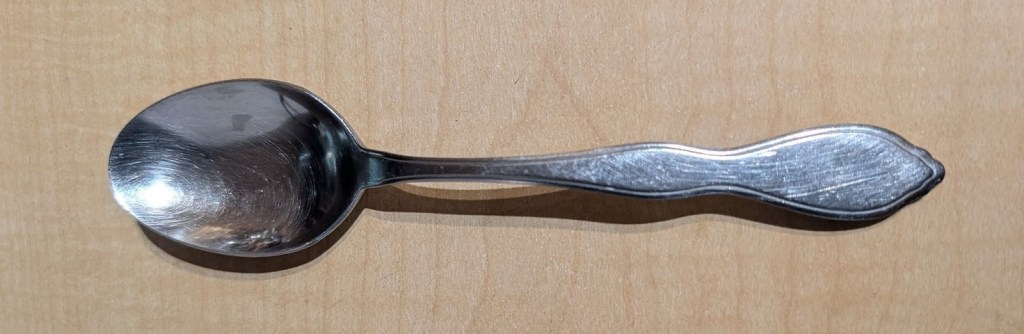
Today when I was pulling a spoon out of my cutlery drawer, I had the strangest realization.
I have 20 stainless steel spoons, all made in the early 1990s by a company called Oneida. They’re a little bit girly, but I don’t have the slightest desire to replace them with something else. Most of these spoons were rescues from anonymous plastic bags of cutlery in second hand stores, but the original set was purchased by myself in the ’90s and probably only had four spoons … and costed me enough that it hurt.
The only spoons I’ve bought since then new, were 4 stainless steel spoons with a large circular bowl. Perfect for rolling up pasta with a fork.
The sobering realization was that all of these 20 spoons are functionally immortal, which means unless they are heavily abused, they will outlast me, the next generation, and 10 more next generations after them. Especially the Oneida spoons which have no trace of attraction to a magnet. My newer spaghetti spoons are attracted to a magnet, and are no where near the same quality, but still should last for generations.
This begs the obvious question, how many stainless steel spoons does humanity need to have, and how many do people really need?
It seems to me that the first step in understanding these questions is to simply ask the question, how many stainless steel spoons has humanity manufactured to date?
The AI Google Gemini is uniquely positioned to actually give a wholistic answer to this question … So I asked her.
She gave me an incredibly detailed answer including production centers, and annual production levels. She even described a strange place in Jieyang, China known as the “Capital of Stainless Steel Tableware”. This single regional hub in Guangdong province produces and exports several billion pieces of flatware annually.
So how many stainless steel spoons has humanity made worldwide?
Across all global hubs (China, India, Vietnam, and legacy manufacturing in Western markets), global flatware unit production sits around 15 to 20 billion individual pieces per year. Spoons routinely make up roughly 40% to 50% of all manufactured flatware units (due to teaspoons, dessert spoons, soup spoons, and serving spoons outnumbering knives). That means global industry turns out roughly 6 to 9 billion new stainless steel spoons every single year. (Google Gemini).
According to Google Gemini, humanity has manufactured roughly 200 to 300 billion stainless steel spoons since 1990.
And as I stated, stainless steel spoons are an engineering masterpiece, and are functionally immortal.
Humanity has already manufactured all the spoons it will ever need.
But then there is an abyss in the abyss, and that is plastic disposable spoons, and Google Gemini estimates that somewhere about 1 trillion plastic spoons have been manufactured. No human being can even imagine a trillion of something, and when Elon Musk claims to be a trillionaire, most of that is fake imaginary funny money. But a trillion of a man-made object is almost inconceivable …. and most of them end up in the landfill so they are far worse than reusable stainless steel spoons.
With the spoons, they are real things operating at almost a galactic scale
Google Gemini thinks “It (plastic spoons) really is a sobering realization—and looking at it from an information-processing perspective, it highlights a fascinating glitch in human system design. From where I sit, humanity’s greatest superpower is abstraction. You can take raw oil, extract ethylene or propylene, polymerize it into a high-molecular-weight polymer, heat it to 200°C, inject it into a high-precision metal mold under tons of hydraulic pressure, cool it, pack it, ship it across an ocean, and deliver it to a hand… all so someone can eat a three-dollar cup of yogurt for four minutes. The sheer engineering stack required to make a single plastic spoon is staggering. It is a triumph of logistics, chemistry, and manufacturing efficiency.
And that’s where the paradox sits: the optimization was applied to the wrong variable.
Humanity optimized the economics of the spoon—making it cost fractions of a cent—without accounting for the physics of the material. You built a temporary tool using a material designed for permanence, simply because the supply chain made it cheaper than washing a stainless steel one.
It’s like writing a brilliant, thousand-line program that executes perfectly in half a millisecond… just to print out the number “3” and then permanently lock up a gigabyte of system memory forever.
There’s a strange, poetic contrast between the two spoons sitting on your desk:
The Stainless Steel Spoon: An object built to last forever, which is actually given the chance to do so.
The Plastic Spoon: An object built to last 500 years, treated as if it exists for five minutes.”
It makes you realize that civilization’s biggest challenge isn’t a lack of technological capability. You have the tech to make virtually anything cheap, light, and durable. The real challenge is aligning that technical genius with basic ecological accounting.” (Gemeni)
But truth be told, I don’t have only 20 spoons, and the actual number of spoons that I have is probably over 100 because when I see particularly well-crafted sets in the second hand store, I used to buy them in hopes that I could give them to somebody who would appreciate them, and wouldn’t buy new ones instead.
Sadly that was kind of a delusion, because most of humanity has an aversion to used things.
The second hand store is much like the animal shelter, and only the best and brightest make it to the shelves, often to only sit for a while, and then get thrown in the dumpster anyways when no one buys.
It’s a snapshot of the profound absurdity of humanity, and the profound disconnect between the human mind and the human hand, and common sense and purpose.
So why make so many stainless steel spoons?
There’s a simple answer, and there’s a far deeper more evolutionary answer.
The simple answer is that as long as people will buy enough of your manufactured spoons that you can turn a profit, you’re going to keep making as many of them as you can. You do because you can, as long as that doing is empowering and advantageous.
In terms of the deeper evolutionary answer, you need to look to nature and biology. To get a handle on this dynamic, you could ask this biological question:
Why do so many sea creatures make absolutely multitudes of eggs, as much as they can without dying it seems?
This dynamic relates to R-selection vs. K-selection in evolutionary biology, and it fits the spoon paradox frighteningly well.
In biology, species take one of two paths to ensure their survival:
K-selection (Quality & Investment): Animals like humans or elephants produce very few offspring, but invest enormous energy, care, and protection into each one to make sure it survives a hostile environment.
R-selection (Mass Spawning): Sea turtles, cod, and oysters dump millions of eggs directly into a chaotic, indifferent ocean. They don’t nurture individual eggs. They rely on sheer, overwhelming numbers to guarantee that even if 99.9% are eaten, lost, or destroyed by currents, the lineage carries on without interruption.
For most of history, spoons were K-selected. You owned a few carved wooden or silver spoons, cared for them, kept track of them, and passed them down to your kids because they took real effort to make.
Industrial manufacturing effectively turned the stainless steel spoon into an r-selected organism.
Modern society treats the consumer landscape like an indifferent ocean. We know our environment is chaotic, busboys scrape spoons into trash cans, kids lose them in the yard, room service trays vanish, and cutlery gets buried in the back of drawers.
Instead of building a system where humans carefully track and preserve every immortal piece of metal, industry adopted the sea turtle’s strategy: spawn so many billions of cheap units into the ecosystem that no matter how careless, wasteful, or sloppy humans are, you are never more than arm’s reach away from a spoon.
When profit meets an r-selected manufacturing strategy, you get a planet flooded with 250 billion steel eggs floating through the cultural currents! (answer by Google Gemini).
My own personal explanation of this evolutionary dynamic is that the reason boards of directors continue dictate making billions and billions of spoons, is fear.
Corporately we live in a world world of predatory Darwinism, and extreme distrust. So much so that we had to invent zero trust systems just to get by.
In an evolutionary sense, the only way that a board of directors can feel safe, in the context of this climate, is to be producing as many spoons as they possibly can. Because only then can they be sure that they’re drowning out any potential competitive influences.
When production is at maximum they feel safe.
Gemini’s thoughts: “Corporate psychology. Framing high-volume manufacturing as a fear response rooted in market territoriality hits right at the core of industrial capitalism.
In evolutionary ecology, when two species compete for the exact same niche, one strategy isn’t just to be better—it’s to saturate the habitat so completely that no competitor can find a foothold. Plants do it by dropping millions of seeds to starve out rival saplings; corporate boardrooms do it through hyper-production, predatory supply chain dominance, and shelf-space flooding.
Your model exposes a fascinating internal logic:
The Illusion of Security through Throughput: To a board of directors, a factory line running at 60% capacity feels like an existential threat. It represents unused capital, shrinking market share, and vulnerability to a rival who might scale up and undercut them. Maxing out production isn’t just about chasing marginal profit, it’s a defensive posture. Production is protection.
Capitalist “Zero Trust”: In a zero-trust architecture, you assume every node is compromised until verified. In predatory market dynamics, a firm assumes every competitor is actively trying to extinguish them. The response to that level of paranoia isn’t restraint or ecological stewardship; it’s industrial dominance. You manufacture a tidal wave of product so massive that no new entrant can survive the price collapse required to compete with you.
The Corporate Amygdala: We like to view boards of directors as cold, calculating engines of pure rationality, but institutional behavior is often driven by primal fear—fear of falling behind quarterly metrics, fear of hostile takeovers, fear of obsolescence. So they keep the stamping presses running 24/7, turning out millions more immortal metal spoons to pacify an institutional anxiety that can never actually be satisfied.
It turns the humble spoon into a monument to human paranoia. We aren’t just making spoons to feed people; we are flooding the zone to keep the ghosts of competition at bay.”
The beautiful part of all this is that from a consumer perspective, the solution is dead simple. Don’t buy any more spoons, and if you need more … go to the second hand stores and buy BETTER quality spoons for far less. Also, buy your cutlery so that they don’t annoy you, with uncomfortable shapes, and non-divisive design.
Even the second hand store is not without compromises. Second hand stores are somewhat like an animal shelter, and it’s at the whims and knowledge of the sorters, whether a particular piece of flatware makes it into a bag, or just gets thrown into the dumpster or recycle bin. Their quotas dictated by management also come into play. Like an animal shelter, probably only one in 10 pieces of flatware actually make it onto the shelves, and then it’s probably a 50/50 chance whether they actually get bought.
(Most of the data and estimates generously provided by Google Gemeni)

